

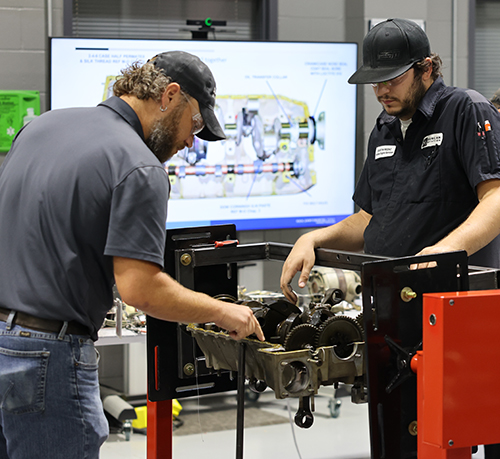
As the aviation industry began to face a growing shortage of airframe and engine technicians, Duncan Aviation’s Vice President of Maintenance Jeremy Rangel recognized the need to build talent from within.
He led the development of a structured Apprenticeship Program that allows team members to earn while they learn—gaining hands-on experience while preparing for A&P certification. In 2019, the program reached a major milestone by earning national recognition from the US Department of Labor as a registered Apprenticeship Program. Our Lincoln and Battle Creek facilities utilize this program and our Provo facility partners with a local school to provide a similar pathway to certification.
In conjunction with other certification programs offered through our Technical Education Center, more than 270 team members have earned one or both of their A&P certificates. These innovative career opportunities have helped provide a pipeline of skilled technicians who learn how we provide and ensure consistent service quality.
Learn more about the Duncan Aviation Apprenticeship Program.

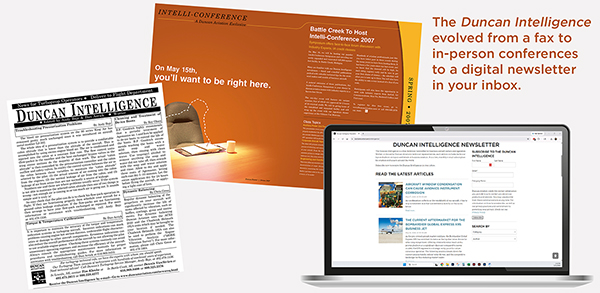
Launched in 1997, the Duncan Intelligence newsletter began with a straightforward mission: to bridge the gap between Duncan Aviation’s technical experts and business aircraft operators. Born from the frequent inquiries our Tech Reps handled, the Duncan Intelligence aimed to share technical and operational insights without a sales pitch.
In the beginning, the newsletter was a one-page document covering five core airframes and the Honeywell TFE731 engine. These were physically printed or faxed to roughly 2,000 mechanics and flight departments per quarter. The content focused on practical advice—such as proper tool usage and interpreting Service Bulletins—which resonated deeply with the community. DOMs didn’t just read them; they pinned them to toolboxes and called Duncan Aviation if an issue was late.
As Duncan Aviation expanded its capabilities, so did the newsletter. Coverage grew to include the most popular business aircraft and engines. Over the years, to keep pace with technology, the delivery method shifted from the fax machine to PDF attachments, eventually becoming the streamlined, web-based digital newsletter used today.
Today, Duncan Intelligence has scaled from a small local outreach to a global resource, reaching more than 15,000 monthly subscribers. While the delivery method has changed, the core formula remains the same: providing free, expert-level technical advice on nearly every aspect of owning and operating a business aircraft, including aircraft, engines, installations, paint, interior, components, parts, and aircraft sales. It continues to serve as a vital, interactive communication tool that reinforces Duncan Aviation’s position as a leader in technical expertise.
If you don’t receive it, sign up now!

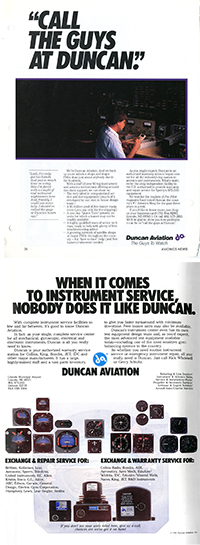
60 years ago, in 1966, Duncan Aviation’s Avionics & Instruments Shop was started. As aircraft technology advanced, so did our capabilities. We slowly became the top US seller of critical avionics equipment, such as radar, autopilots, and radios, giving customers access to the latest tools for safer, more efficient flights.
Many customers found Duncan Aviation through our send-in avionics services, which began in the early 1970s. But our support didn’t stop at the sale. Recognizing that uptime matters, we began helping customers troubleshoot issues over the phone. This led to the creation of a dedicated team of Avionics Technical Representatives—experts who became trusted problem-solvers and well known throughout the industry for getting aircraft back in the air faster.
By 1981, customers benefited from even greater peace of mind when Duncan Aviation became an authorized warranty service station for all major avionics OEMs of the era, including Collins, King, Bendix, JET, IDC, AIM, and EdoAire. From routine instrument service to urgent repairs, operators could rely on one source for precise, dependable support across mechanical, gyroscopic, electrical, and electronic instruments. Our signature black-and-white striped boxes were seen in aircraft hangars throughout the world.
In 1985, Duncan Aviation was voted the Best Avionics Shop in the country by readers of Professional Pilot magazine. We held that top spot for the next 25 years, until the magazine discontinued that particular category.
To support growing customer demand, the Lincoln Avionics and Instrument Shop relocated in April 1997 to a dedicated facility on the west side of the Lincoln Airport. The move expanded capacity by 50 percent and consolidated more than 90 Technicians and CARs (Customer Account Representatives), with more than $10 million in equipment and inventory to improve turnaround times and service support.