

-2.jpg?language_id=1)
The history and growth of Duncan Aviation’s Accessories Department is driven entirely by the expanding needs of the hangar floor. In the early days, Accessories wasn’t a department at all; it was a set of tasks, such as maintaining batteries, wheels, and life vests, performed by A&P technicians directly on the hangar floor.
The story goes that as Donald Duncan sold new aircraft models like Learjets, King Airs, and Barons, the technicians had to figure out how to support them in-house. Over time, our teams built the expertise in-house.
Duncan Aviation began investing in the tooling and talent necessary to keep units airworthy without relying on external vendors. By the early 1990s, the department found itself competing with large companies that specialized in hydraulics or pneumatics. To remain competitive and keep turnarounds fast, our technicians evolved into niche experts, eventually moving off the hangar floor and into dedicated shop spaces.
Each time Duncan Aviation added a new authorization, built a new hangar, or opened a new facility, demand for in-house accessory services increased. The department today has more than 80 technicians across three full-service MRO locations, offering comprehensive accessory capabilities like Batteries/Power Supplies, Electronics, Electromechanical, Hydraulic Fluids/Fuel, Hydrostatic, Landing Gear, Machining & Welding, and Pneumatics.
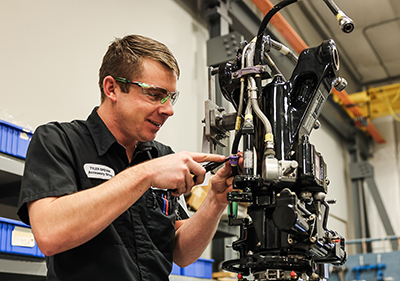
Landing gear services were originally handled by one or two hydraulic technicians at the back of the hangar in Lincoln. As the company grew and demand dictated, it has grown to include 20 landing gear technicians and several OEM authorizations at all three of our MROs.
Since 1978, Duncan Aviation has worked on an average of 85 landing gear sets each year.
Today, we can work on the landing gear for the following aircraft:
View the full list of Duncan Aviation's Repair and Overhaul services.

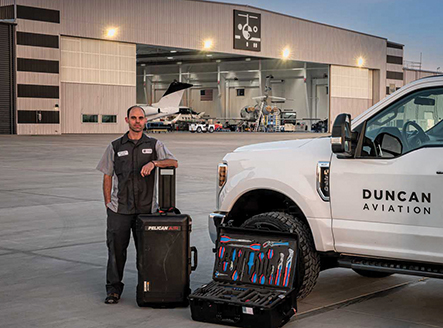
Duncan Aviation’s Rapid Response Teams reduce downtime for customers facing AOG and unscheduled maintenance events.
In 2000, Duncan Aviation formed its first team of mobile-ready turbine engine technicians in the Dallas, Texas, area, launching the company’s first Engine Rapid Response office. Similar teams were soon established in Chicago, Illinois; Denver, Colorado; Phoenix, Arizona; and Fort Lauderdale, Florida, expanding geographic coverage for customers.
In 2019, the RRT (Rapid Response Team) expanded to include mobile airframe services in response to growing customer demand for on-site AOG support and inspection capability. Three airframe-focused Rapid Response teams were added at our MRO facilities, bringing 18 additional airframe technicians and eight fully stocked service vehicles on call. This expanded network allows customers to resolve engine and airframe issues more quickly, helping return aircraft to service with minimal disruption.
Today, airframe and engine RRT has more than 48 factory-trained technicians who travel more than 250,000 land miles annually in 35 fully stocked service vehicles, performing nearly 1,500 AOG and in-field events. All are well-equipped with the necessary tooling and a long list of capabilities, including troubleshooting, routine periodic inspections, airframe inspections, maintenance tasks, discrepancies, vibration surveys, on-the-wing repairs, engine removals and reinstallations, and line maintenance, including LRU (Line Replaceable Unit) changes and borescope inspections.
See the full list of Rapid Response locations.

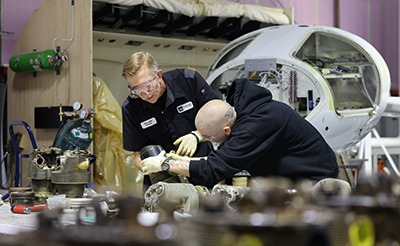
Consistent quality and safe outcomes depend on well-trained teams. That’s why Duncan Aviation invests approximately $10-12 million each year in internal and external training and supports a learning culture that includes more than 1,100 internal course titles offered across the company.
We invest in technical and leadership development to ensure knowledge keeps pace with evolving aircraft, regulations, and technologies.
By ensuring our skilled technicians are equipped with current expertise, we can help operators meet today’s requirements while preparing for what’s next.