
-topaz-enhance-edit.jpg?language_id=1)
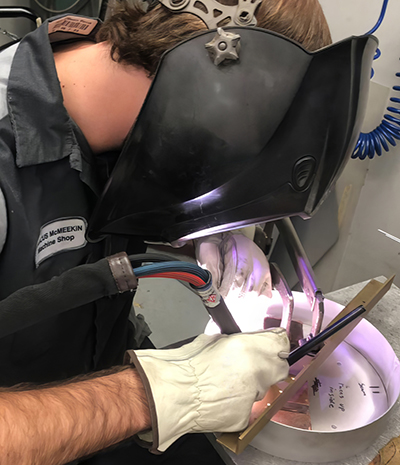
For customers, stronger repairs and dependable turnaround often come down to what an MRO can do in-house. That’s why Duncan Aviation’s Machining and Welding department earned AWS D1.2/D1.2M Structural Welding Code—Aluminum certification in 2021, expanding our capabilities with advanced digital welding technology. The certification allows us to perform complex aerospace and structural repairs with greater precision while maintaining strict safety and quality controls.
Those benefits extend beyond the aircraft itself. Our Welding and Machining teams have built hundreds of engine stands, fixtures, lifting devices, and ground support equipment—custom tooling that supports maintenance and modification work across the enterprise and helps projects move efficiently from start to finish. The same expertise also enables us to support select regional industries with specialized fabrication needs.
Customers can appreciate fewer outside dependencies, consistent quality, and repairs and tooling built by teams who understand how every component affects the aircraft as a whole.
Discover our full capabilities here.
Duncan Aviation has continually expanded its aircraft paint facilities to meet evolving customer needs.
Aircraft painting began in Lincoln in 1979, followed by a series of facility expansions designed to increase capacity, capability, and flexibility for customers. A 20,000-square-foot paint facility opened in Lincoln in 1990, tripling paint capacity at the time. Additional investments included a dedicated paint facility in Battle Creek in 2007; a 45,000-square-foot paint facility in Lincoln in 2012; and a 53,000-square-foot paint facility in Provo in 2019.
The Provo facility became the first truly green business aviation paint facility in the United States, using an RTO (Regenerative Thermal Oxidizer) system that removes more than 99.7 percent of volatile organic compounds before air is released—allowing customers to meet environmental expectations without compromising finish quality.
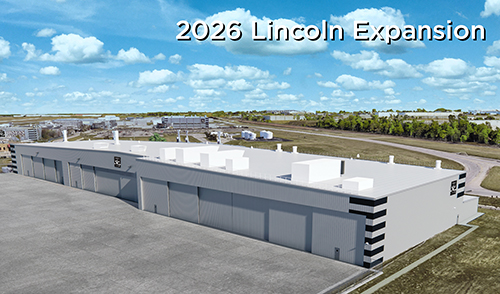
In 2026, Duncan Aviation will add a 32,500-square-foot, dual-bay paint hangar in Lincoln, directly connected to the existing paint facility there. The new hangar supports the painting of more intricate paint schemes, accommodates larger aircraft such as the Gulfstream G650, Dassault Falcon 10X, and Bombardier Global 7500, and provides customers with faster response for unscheduled needs including touch-ups, registration changes, and short-lead-time paint work.
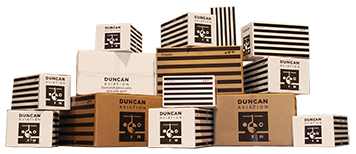
Long before overnight shipping became standard, Duncan Aviation was looking for better ways to move critical aircraft components. In 1974, we began using a new overnight delivery service from Federal Express to accelerate the shipment of avionics and instrument parts. That decision significantly improved turnaround for send-in repairs and helped customers reduce aircraft downtime at a time when fast logistics were far from routine.
That early commitment to speed and reliability shaped how our shipping and receiving operation evolved. Over the last 20 years, we’ve consolidated all shipping functions into a single facility with defined inbound and outbound processes, transitioned from handwritten paperwork to RF scanners and digital tracking, and upgraded packaging to Korrvu® retention and suspension inserts that better protect sensitive components during transport. The shipping team more than doubled. And we were able to obtain our own URSA (Universal Routing and Sort Aid) code and a separate ZIP code, which allows us to streamline FedEx Express deliveries and ensure faster part arrivals.
In 2025 alone, we processed 104,483 inbound and outbound packages supporting maintenance, repair, and modification work across the enterprise.