
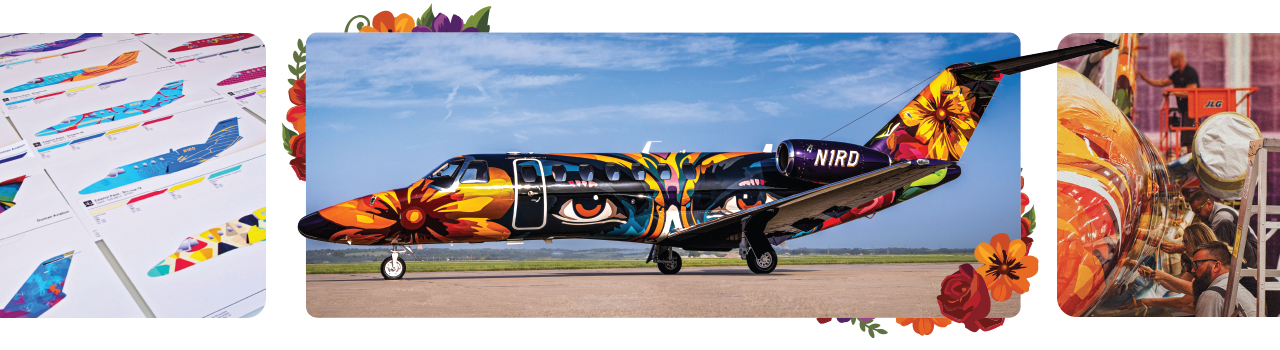
Before it had a name, before anyone counted the colors, and before eyes, flies, flowers, stencils, and hand-laid details covered nearly every inch, N1RD was a white Citation CJ3+ with factory stripes.
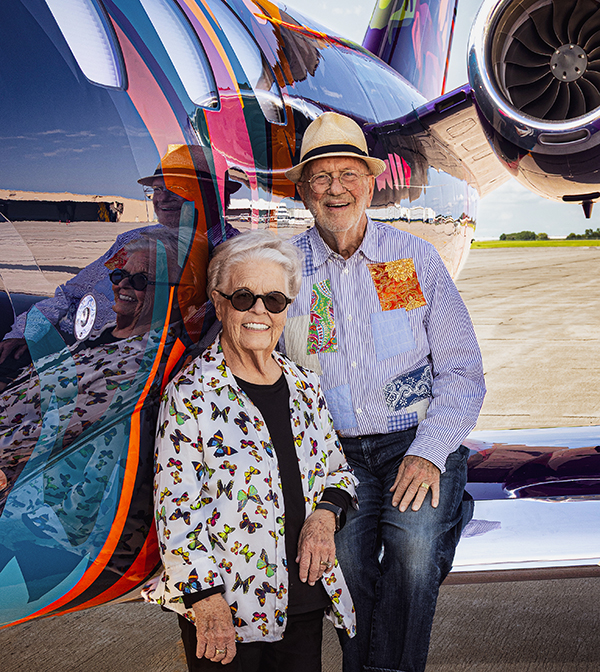
Robert and Karen Duncan saw a blank canvas: a chance to celebrate Duncan Aviation’s creativity, challenge the team, open the new Lincoln, Nebraska, paint hangar with a statement, and create an aircraft that epitomizes Duncan Aviation.
What emerged from the new 32,500-square-foot paint hangar was a 46-color flying work of art—the most intricate paint design Duncan Aviation has ever completed. For Robert, the reaction is simple: “Wow.” Karen’s question epitomizes the creative brief: “How outrageous can we get?”
Robert embraces it. “This is completely outrageous,” he says. “It speaks to the creativity and the outstanding job that Duncan Aviation does day in and day out.”
For Robert and Karen, outrageous is part of a longer story shaped by art, travel, and airplanes that become conversation pieces. More than 60 years after friends painted “Just Married” on Robert’s Beechcraft Travel Air during their honeymoon, that same spirit surrounds a Citation CJ3+ in color, movement, eyes that look back, and flies that feel like an inside joke.
Karen’s explanation for the flies is simple. “Because we’re flying.”
That is the charm of N1RD. It is bold because Robert and Karen encouraged boldness, complex because the team could make it possible, and powerful because every detail shows what happens when imagination and craftsmanship meet.
“This whole process actually started two years ago,” says Lead Designer Hannah Mann. “We were all really excited to come up with something truly unique and custom.”
The aircraft began as a CJ3+ in a factory paint job, white with stripes, after spending its first several years in Peru. Robert says they “couldn’t wait” to make it a Duncan Aviation design.
The challenge began with inspiration artwork from Robert and Karen. Artists throughout Duncan Aviation’s Paint and Design teams submitted ideas, and roughly 30 initial schemes became 15 updated concepts.
Completions Sales Representative Angie Coleman says Robert and Karen wanted Duncan Aviation’s artists to bring forward their own ideas, then trusted the teams to narrow, revise, and refine.
Karen says she could have fallen in love with “6 or 8 different schemes,” but one detail kept coming forward: the flies.
When the final concept appeared, the decision became clear. “When we saw this one at the last meeting, everybody in the room said yes,” Karen says, “this one’s the one.” Robert’s direction was simple: “Go for it.”
The selected concept came from Paint Master Specialist Troy Reinke, who wanted something unique, eye-catching, and unlike anything Duncan Aviation had painted before. His inspiration leaned into Mexican art and culture, a personal connection to the Duncans and their longtime ties to Puerto Vallarta.
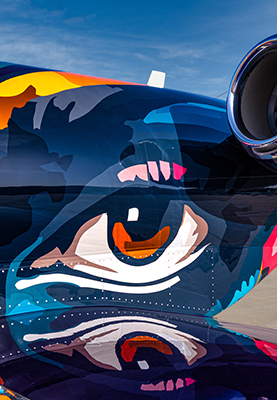
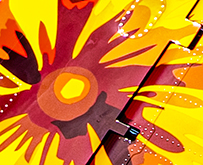
The flies appear on the tail, nose, and nacelles. They sit alongside another standout element: the eyes, which Robert says “jump right out at you.”
Once the concept was selected, the real work began.
Troy’s original artwork included fades, highlights, shadows, and artistic details that had to be translated into something the Paint team could apply to an aircraft. Hannah’s design work became critical.
“I took Troy’s drawing and split that out into individual shapes and pieces,” Hannah says. “That’s where the 46 colors came from.”
Paint Team Leader Brandon Boyer says the fades had to become solid shapes, and once that happened, the path was clear. “There was no fear,” Brandon says. “It was just a time concern.”
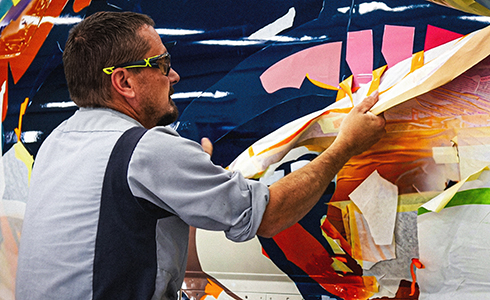
Each color added complexity. Every section had to be planned, masked, painted, unmasked, and protected with precision. Angie says scheduling required close coordination because every color meant another round of masking and labor.
The CJ3+ demanded focus, but the team continued supporting its regular flow of customer aircraft with the same attention to detail.
The planning continued in Duncan Aviation’s new paint hangar. Robert wanted the CJ3+ to be the first aircraft painted there, and the team made that happen. Troy says the bigger, brighter space helped, and Brandon says the clean, climate-controlled facility made a practical difference during 100-degree weather.
The team broke the design into sections, cut stencils, and prepared the aircraft so the scheme could be applied accurately at full scale. At least 25 team members touched the aircraft before completion, including layout, paint, project coordination, sales, design, and leadership support.
Brandon credits Paint Crew Team Leader Trevor Reinke, who led the day-to-day paint effort while the team supported other aircraft. Trevor says a project like this takes “a tremendous amount of time, attention to detail, and teamwork.”
Project Manager Tony Chipman helped coordinate communication and remove roadblocks, but he points the credit back to the team.
“I have complete trust in our team members to do their jobs,” Tony says. “Their passion comes out in everything they do.”
For Tony, the aircraft is more than a painted machine. It is art unlike anything that could hang on a wall.
“It is one thing to paint this on a wall in an alley somewhere or a piece of canvas,” Tony says. “But I have never seen a piece of canvas or a wall maintain flight at 400+ mph and 40,000 feet.”
Unlike traditional art, this project had to meet FAA and manufacturer standards, use approved materials, withstand flight, and still inspire conversation.
For Angie, projects with the Duncan family are especially rewarding.
“Working with the Duncan family is the absolute best,” Angie says. “They let our designers design and our paint teams paint.”
Although Duncan Aviation has completed many colorful custom aircraft, this one stands apart. The previous family aircraft, N1KD, used roughly 26 colors. This CJ3+ nearly doubles that count.
“It’s the most we’ve ever done,” Angie says.
Troy describes the finished aircraft in three words: “Unique, colorful, and eye-catching.” After two years of teamwork, the reaction he hopes for is simple: “Jaw drop.”
That pride is exactly what Robert and Karen hope the finished aircraft reflects. Robert says the Design and Paint teams should be “really, really proud,” and Karen says the teams should get as much attention as the airplane.
Robert expects N1RD to do what Duncan Aviation aircraft have always done: start conversations, draw cameras, and make people smile.
“I have a great big smile every time I see it,” he says. “It’ll brighten everyone’s day.”
More than anything, he sees the CJ3+ as a statement about Duncan Aviation itself: “What we’re capable of, what we love, how much fun the company is.”
For Duncan Aviation, the Citation CJ3+ represents a milestone in creativity and craftsmanship: our most complex paint design to date, the first aircraft completed in Lincoln’s new paint hangar, and a vivid example of what happens when customers trust the team to turn inspiration into reality.