
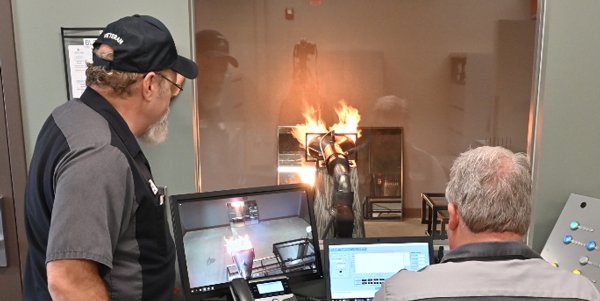
Behind every completed aircraft interior is a layer of work most passengers will never see, but it plays a critical role in safety, certification, and long-term aircraft value. At Duncan Aviation, that work happens in the Burn Lab.
Schedules can get tight, and there is always pressure to keep projects moving. Even so, the priority in the lab stays the same. Every material that goes into an aircraft needs to meet fire safety requirements, no exceptions.
 In short, pretty much anything that could create a fire hazard.
Burn testing comes in all shapes and sizes. It covers everything from large cargo containers down to wiring, insulation, and even containment systems for lithium-ion batteries. If a material could create a risk during flight or after an emergency landing, it needs to be evaluated.
From there, the focus shifts to how those materials actually behave in a fire. How quickly do flames spread? How much smoke and heat are produced? Can fire burn through into areas that affect critical systems? That last question is where things can become serious, and it gets a lot of attention.
All of this work is driven by FAA and DOT requirements. These are not guidelines; they are regulatory standards that must be met to operate in US airspace. Once you start working with international operators, things can vary a bit. The intent is similar, but the details are not always the same, making expert guidance essential when working across global regulatory environments.
Not all materials behave the same way in a fire, so the testing is not one-size-fits-all. The method depends on the material and how it is used on the aircraft.
Some of the more common tests include:
Altogether, there are more than ten different burn test methods. The right one depends on the material, where it is installed, and sometimes how the aircraft will be operated. It is not always as straightforward as it might seem at first.
It is easy to think of burn testing as just another requirement to work through, but problems show up quickly if it is not done correctly.
Some of the more common issues include:
Most importantly, skipping or cutting corners on testing can compromise safety in flight and in emergencies, creating a real risk to passengers, crew, and the aircraft itself.
At the end of the day, the goal is simple. The materials going into an aircraft need to perform the way they are expected to, especially in situations where there is very little margin for error.
At Duncan Aviation, the Burn Lab is where compliance meets real-world engineering. By ensuring every material performs as expected under fire conditions, the team helps keep aircraft safe and projects on schedule.
It’s a behind-the-scenes effort, but one that makes all the difference when it matters the most.
November 2026
November 2026
November 2026
October 2026
September 2026