Few business jets have remained relevant as long as the Dassault Falcon 900. First flown in 1984, the 900 grew from the Falcon 50 concept into a substantially larger, three-engine business jet. More than four decades later, the basic cabin and airframe remain competitive. The story is one of continuous refinement: Dassault kept the basic airplane while improving its engines, fuel capacity, range, avionics and aerodynamics. Those changes explain why Falcon 900s that look remarkably similar on the ramp can differ in value by many millions of dollars.
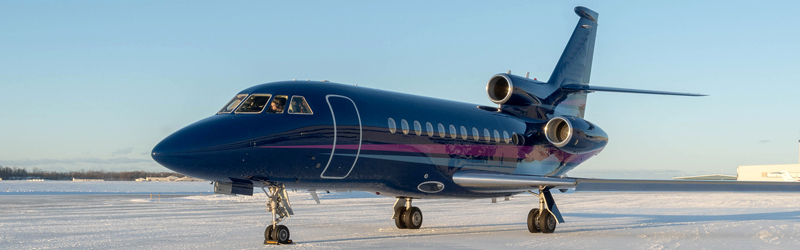
Production: approximately 1986-1997 | Approximately 160 Falcon 900/900Bs combined
The original Falcon 900 established the architecture for the entire family. The 900B became the mature early version, using three Honeywell TFE731-5BR engines producing roughly 4,750 pounds of thrust each and providing approximately 4,000 nautical miles of range.
Early avionics were advanced for their era but are far removed from today's integrated flight decks. Many 900Bs have since received major upgrades, including newer displays, flight-management systems, WAAS/LPV, ADS-B and FANS/CPDLC. As a result, two aircraft of the same year can have very different capabilities and values.
The 900B's greatest attraction today is acquisition cost. It provides essentially the same large Falcon cabin found in later models - approximately 6 feet 2 inches high and 7 feet 7 inches wide - while typical values can fall around $2-6 million. It is the acquisition-value model of the family, although maintenance status is critical on an aircraft of this age.
Production: approximately 1998-2005 | 25 built
The rare Falcon 900C retained the TFE731-5BR engines and roughly 4,000-nm performance of the 900B but paired them with a later-production airframe and the Honeywell Primus 2000 integrated avionics suite. It is essentially a bridge between generations: 900B-like performance with a substantially newer cockpit.
Approximate values generally fall around $5-8 million. With only about 25 built, individual condition, engine status and equipment have an especially large influence on price.
Production: approximately 1995/1996-2003 | Approximately 118 pre-EASy aircraft
The 900EX was the major mechanical step forward. Dassault replaced the -5BR engines with three 5,000-pound-thrust Honeywell TFE731-60s, increased fuel capacity and maximum takeoff weight, and moved range into roughly the 4,500-4,700-nm class. The -60 proved successful enough to remain in the powerplant for the later DX and LX.
Early 900EX aircraft generally use the Honeywell Primus 2000 glass cockpit. Compared with a 900B, an EX gives the buyer the same basic cabin with more thrust, more fuel, greater range, stronger hot-and-high and intercontinental capability, and a newer avionics architecture. Approximate values generally run around $8-12 million.
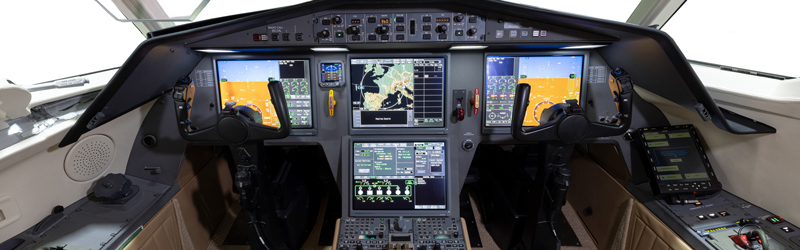
Production: approximately 2003-2010 | Approximately 122 built
The 900EX EASy retained the successful TFE731-60 engines and long-range performance of the EX but introduced Dassault's EASy flight deck, developed around Honeywell's Primus Epic architecture. Large-format displays and much deeper integration of navigation, flight planning, communications and aircraft systems fundamentally changed how pilots interacted with the airplane.
This avionics leap remains visible in resale values. Later EX EASy aircraft can command roughly $11 -17 million despite having essentially the same passenger cabin and similar fundamental performance as earlier EXs. The premium reflects age, avionics generation, and long-term operational relevance.
Production: approximately 2005-2010 | Roughly two dozen built
The relatively rare 900DX retained the TFE731-60 engines and EASy cockpit but was optimized around somewhat shorter missions, with roughly 4,100-4,300 nm of range. For an operator who does not routinely need maximum intercontinental range, the DX offers much of the newer Falcon technology without paying specifically for the EX's maximum-range capability. Approximate values generally fall around $10-14 million.
Production: approximately 2010-present era | More than 80 delivered/in service
The 900LX represents the ultimate development of the original concept. Dassault retained the TFE731-60 engines but added winglets and aerodynamic refinements rather than simply installing more thrust. Range increased to approximately 4,750 nm, while climb and efficiency improved.
The cockpit evolved through EASy and EASy II, bringing increasingly sophisticated navigation, communications, surveillance and situational awareness capability. Yet the passenger cabin remains remarkably similar in fundamental dimensions to the one Dassault designed decades earlier. Newer LX values span a very broad range, commonly from the $18 million into $40 million-plus depending heavily on the year.
The low purchase price of an older Falcon 900 should never be confused with inexpensive ownership. It remains a sophisticated large-cabin jet.
Dassault's maintenance program combines flight-hour, cycle and calendar-based inspections, making major events reasonably predictable. That allows owners to budget ahead and sometimes combine inspections with avionics, paint or interior work.
The obvious issue is three engines. The 900/900B/900C use TFE731-5-series engines, while the EX, EX EASy, DX and LX use three TFE731-60s. When major engine work is due, the owner has three engines to maintain rather than the two found on most competing large-cabin jets. On the other hand, the TFE731 family has a very large installed base and established support network, and programs such as Honeywell MSP can make engine costs more predictable.
On older Falcons, engine times, corrosion and structural inspections, landing-gear status, major scheduled inspections, avionics and records can create substantial value differences between otherwise similar aircraft. A $4.5 million 900B approaching multiple major events may be less attractive than a more expensive airplane that has already completed them. If you’re considering a 900, a very thorough prepurchase inspection is highly recommended as these airplanes have access to the far reaches of the world where they can be exposed to higher corrosive environments and different maintenance practices. For a buyer, the better question is not simply, 'What does it cost today?' but 'What will it require over the next five years?'.
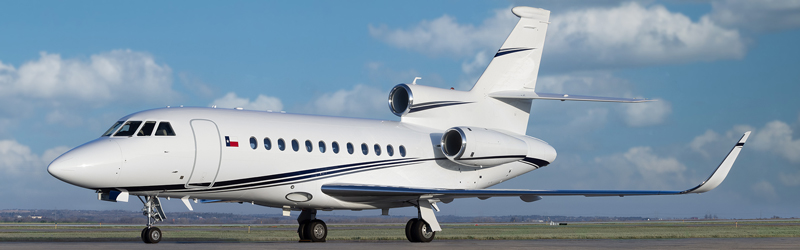
The Falcon 900's real advantage is not that it wins every individual specification comparison. It is the combination of capabilities Dassault managed to put into one airplane.
The 900 family combines a large cabin and intercontinental range with unusually strong short-field performance. The 900LX, for example, requires roughly 5,300 feet for takeoff at maximum takeoff weight under sea-level standard conditions. At a typical landing weight, landing distance is approximately 2,400 feet and Vref is around 110 knots. More revealing, Dassault states that an LX fueled for a 3,000-nm mission can depart from a runway shorter than 4,000 feet at sea level.
Much of this capability comes from the Falcon wing, including leading-edge slats and large double-slotted Fowler flaps that generate substantial lift at relatively low speeds. The practical benefit is access to airports that may be difficult for other large, long-range business jets, potentially putting passengers closer to their final destination.
Payload-range efficiency is another strength. It would be inaccurate to claim that every Falcon carries more payload with full fuel than every competitor; some larger aircraft do better by that measure. The Falcon's strength is its ability to carry a realistic executive passenger load a long distance using a relatively light airframe, efficient wing and comparatively small TFE731 engines with their low fuel burn. The design emphasizes efficiency rather than simply adding size and thrust.
The defining Falcon combination is therefore large cabin, useful payload, long range, relatively low approach speeds and access to comparatively short or demanding runways. The difference in value between generations represents nearly four decades of technological improvement layered onto a basic design that Dassault got remarkably right from the beginning.
To find out if the Falcon 900, or any corporate aircraft, is the right fit for you, you can utilize the Duncan Aviation Aircraft Sales & Acquisitions team, which has been buying and selling private jets for more than 70 years and has successfully completed over 3,750 aircraft transactions. We also have two dedicated market researchers and a team of more than 3,000 professionals who work on these aircraft every day. Finding the right aircraft for your operation can be difficult, but it is what we love doing. Give us a call.
To learn more about Duncan Aviation Aircraft Sales & Acquisitions services, please visit us at DuncanAviation.aero/AircraftSales or email us at AircraftSales@DuncanAviation.com.
 Michael Kussatz
Corporate Jet Captain/Aircraft Sales & Acquisitions
Lincoln, NE (LNK)
+1 402.475.2611
Michael Kussatz
Corporate Jet Captain/Aircraft Sales & Acquisitions
Lincoln, NE (LNK)
+1 402.475.2611
November 2026
September 2026
August 2026
July 2026
April 2026