
Accurate airborne weather radar is a critical component of flight safety and operational efficiency. Convective activity, turbulence, hail, lightning, and windshear present ongoing operational challenges, often resulting in delays, reroutes, structural damage, and increased maintenance costs. Advances in predictive radar technology are intended to improve detection accuracy, reduce crew workload, and enhance situational awareness in these environments.
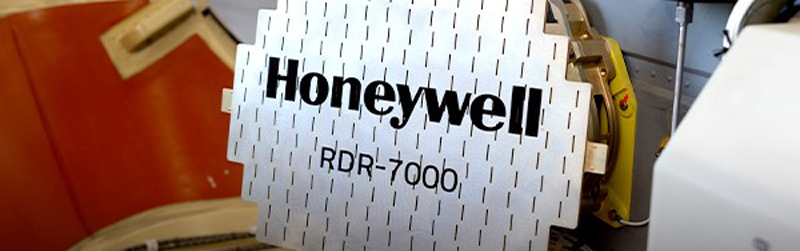
The Honeywell IntuVue™ RDR-7000 Weather Radar System is a solid-state radar designed as a lightweight, single LRU (line replacement unit) for business and rotorcraft platforms. It incorporates automated volumetric scanning and hazard analysis capabilities intended to address limitations commonly associated with legacy magnetron-based radar systems.
Are you getting the most from your weather radar?
Sign up for a technical training here.
Webinar information below
The RDR-7000 uses automated 3D volumetric scanning to analyze weather from an altitude of up to 60,000 feet and out to a range of 320 nautical miles. Rather than relying on manual tilt management to interpret storm structure, the system continuously scans vertical and horizontal volumes ahead of the aircraft.
Traditional magnetron-based systems typically require pilots to manually adjust tilt and gain settings to assess storm tops and vertical development. This manual process can increase workload and introduces variability based on operator technique. In contrast, the RDR-7000 automates tilt control and gain optimization, presenting a processed depiction of storm intensity and structure without requiring continuous adjustment.
The system’s display logic is designed using human factors principles to support rapid interpretation of storm cell location, height, and severity. By presenting volumetric weather data in a consolidated format, the radar reduces the need for mental reconstruction of storm geometry from multiple tilt sweeps.
In addition to reflectivity mapping, the RDR-7000 integrates predictive hazard detection algorithms. These functions analyze storm characteristics to identify areas associated with turbulence, hail, lightning, and windshear risk.
The system provides predictive turbulence detection with reported accuracy of approximately 93 percent under specified operating conditions. Predictive turbulence capability is intended to allow crews to make earlier tactical decisions regarding deviations, altitude changes, or speed adjustments, potentially reducing passenger discomfort and structural stress on the aircraft.
By combining volumetric scanning with hazard analysis, the radar provides both strategic (long-range planning) and tactical (near-term avoidance) weather information.
From an operational standpoint, enhanced detection and earlier hazard identification can contribute to:
Over time, improved avoidance strategies may also help limit unscheduled maintenance events associated with hail strikes, turbulence exceedances, or lightning encounters.
Because the RDR-7000 is designed as a single line replacement unit, installation complexity is reduced relative to more extensive system retrofits. This can simplify upgrades for operators transitioning from earlier-generation radar systems.
For rotorcraft platforms, the RDR-7000 includes maritime surveillance modes to support offshore and search-and-rescue operations. These modes incorporate features such as:
These capabilities are intended to assist crews operating in offshore, coastal, or low-visibility maritime environments where surface target discrimination is critical.
The RDR-7000 supports remote software feature enablement, allowing operators to configure system capabilities based on mission requirements. This approach provides flexibility for fleets operating in diverse geographic and weather environments, without requiring hardware modifications.
Please call a Duncan Aviation Satellite Avionics Sales Manager to schedule your aircraft for this upgrade:
To support proper system understanding and operation, Honeywell is hosting a technical webinar with Aviation International News covering the RDR-4000 and RDR-7000 weather radar systems:
How to Use RDR-4000 & RDR-7000 Weather Radars
March 31, 2026 | Noon EST
The session will address:
Understanding the distinctions between radar generations and their respective operating philosophies is essential to effective use. The webinar is intended for pilots, operators, and technical personnel seeking a deeper understanding of system functionality and best practices.
November 2026
October 2026
October 2026
September 2026
September 2026
