
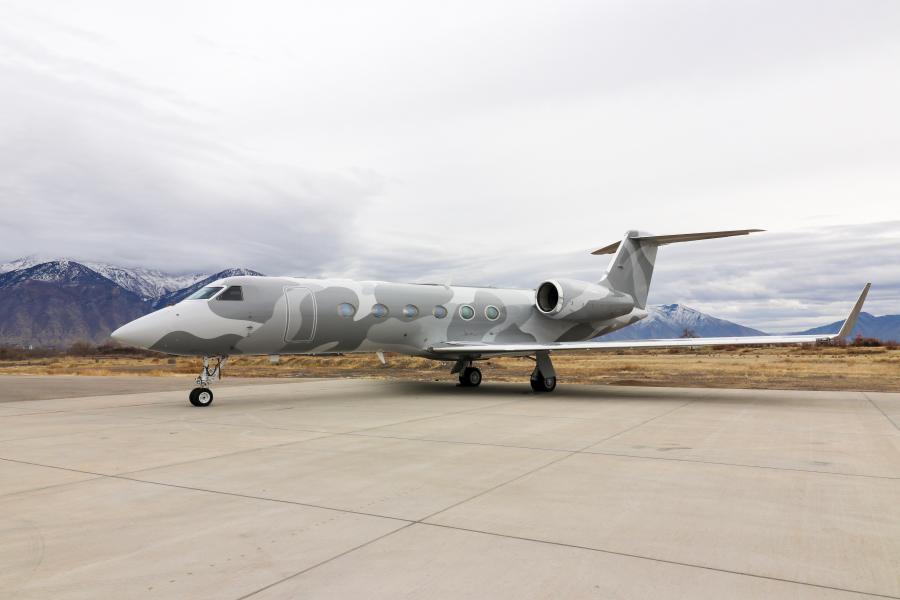
 Duncan Aviation's Provo facility recently refurbished a Gulfstream G450 with heritage-inspired camouflage, residential comfort, custom craftsmanship, and thoughtful innovations tailored to its owner in every detail. Click image for high-res download.
LINCOLN, NEB. — Duncan Aviation recently refurbished a Gulfstream G450 with heritage-inspired camouflage, residential comfort, custom craftsmanship, and thoughtful innovations tailored to its owner in every detail.
For many aircraft owners, a refurbishment is about more than aesthetics. It is an opportunity to tell a story. On this Gulfstream G450, completed by Duncan Aviation’s Provo, Utah, facility, that story unfolds in layers. It is a tribute to family heritage, an exploration of modern design, and a careful rethinking of how comfort and function coexist at altitude.
Led by Senior Lead Designer Molly Pfeiffer, the project pushed creative and technical boundaries, resulting in what may be one of the most distinctive and thoughtfully executed G450 refurbishments flying today.
The journey began with the exterior. The owner came to Duncan Aviation with an idea: a digital camouflage paint scheme. While bold, Pfeiffer sensed it did not fully align with the owner’s personal style. Instead of dismissing the idea, she explored it, bringing a range of more organic camouflage concepts to the initial specification meeting. That decision proved pivotal.
As discussions evolved, so did the concept. Pfeiffer and the owner experimented with scale, color, and pattern, but nothing quite resonated until a casual conversation with the owner’s family revealed a deeper connection. A relative had served on World War II bomber aircraft, many of which featured silver exteriors.
That insight reframed the entire design direction.
Pfeiffer began researching camouflage patterns from the era and eventually landed on “frogskin” camouflage, an organic pattern used during World War II. From there, she reimagined the concept entirely, translating the historical motif into a sophisticated, monochromatic palette of greys.
The result is a tone-on-tone camouflage that reveals itself gradually. From a distance, the aircraft appears sleek and understated. Up close, the intricate pattern emerges, adding depth and visual interest without overwhelming the eye.
Achieving that balance required iteration, with nearly 40 variations explored before finalizing the design.
Equally impressive is how the pattern flows across the aircraft. Duncan Aviation’s layout team executed the vision with precision. The camouflage wraps seamlessly from the fuselage onto the tail and across the horizontal stabilizer, creating a continuous, three-dimensional effect.
“When you stand behind the aircraft and see how it wraps up and over the tail, it is just a really cool look,” Pfeiffer says. “That flow was very intentional from the beginning, even though we were designing it in 2D.”
Translating that vision onto a real aircraft required close collaboration and on-site adjustments to ensure the pattern aligned perfectly across complex surfaces. The result is a paint scheme that feels both dynamic and refined.
Inside, the focus shifts from heritage to hospitality.
The owner’s directive was clear: create a cabin that feels like an extension of home, warm and inviting, and comfortable enough for long-haul travel. Pfeiffer responded by leaning into residential design principles, prioritizing texture, materiality, and livability.
Fabric plays a central role. Seats are upholstered in soft textiles, complemented by leather armrests and bases for durability. The combination strikes a careful balance between comfort and practicality, while the squared-off seat design and clean pull lines lend a modern edge.
To reinforce the cozy atmosphere, fabric is used extensively throughout the cabin, including the upper sidewalls, PSU panels, and valences. This continuity softens the space and creates a cohesive, lounge-like environment.
Natural materials further enhance the effect. A flat-cut walnut veneer, selected with the owner’s close involvement, features prominently. Its figuring runs in different directions depending on the monument, adding subtle variation while maintaining a unified look. A satin finish preserves the wood’s natural character without excessive gloss.
In a move that underscores Pfeiffer’s commitment to warmth and cohesion, the lower sidewalls are also finished in veneer, a relatively uncommon choice. With multiple fabrics already in play, extending the walnut downward helps anchor the cabin and ties the design together.
Beyond aesthetics, the aircraft underwent extensive modifications that rethink standard G450 features.
The drinkrails and table boxes were redesigned with squared-off profiles and accented with metal trim, introducing a crisp, contemporary feel. New cupholders and updated hardware, including sleek disc latches, modernize the tactile experience throughout the cabin.
The conference area received a particularly innovative upgrade. Traditionally supported by two narrow legs, the table now features a single, sturdier pedestal. This not only improves stability but also enables a dual-purpose function. The space can be converted into a lounge with a custom mattress that spans the seats and table. The adjustable pedestal ensures the surface aligns perfectly with surrounding elements, enhancing both comfort and usability.
In the galley, practicality meets refinement. Luxury vinyl tile flooring provides durability, while new faucets and frosted sliding doors add a contemporary touch. Even the microwave, often an unavoidable visual distraction, was addressed with a custom veneer cover that allows it to blend seamlessly into the cabinetry when not in use.
Countertops in darker-toned Corian introduce contrast against the walnut veneer, while updated ashtrays and metal accents continue the theme of understated sophistication.
Some of the most impactful changes are found in the aft lavatory, where functionality was significantly enhanced.
Recognizing the owner’s height, the team raised and expanded the headliner to provide additional headroom, eliminating the need to duck while using the sink. Storage was reconfigured with fully extendable drawers, each redesigned for improved accessibility and finished with modern paddle latches.
Additional features, such as integrated knee pads, address practical concerns like stability during turbulence. It is a subtle but meaningful example of how personalized design can improve everyday usability.
Even the sink tells a story. Unable to source a suitable sink option for aviation use, the team created a custom piece and powder-coated it to match the surrounding finishes. The result is both distinctive and perfectly integrated.
While the cabin emphasizes warmth and texture, it is fully equipped with modern technology. A Collins Aerospace Venue cabin management system anchors the experience, with undermounted touchscreens maintaining a clean visual profile.
Power outlets are thoughtfully positioned for easy access, and new lighting throughout the aircraft enhances both functionality and ambiance.
Taken as a whole, the aircraft represents a comprehensive reimagining of the G450 platform. Nearly every surface, system, and detail was reconsidered, resulting in a jet that feels entirely bespoke.
For Pfeiffer, the project stands out not only for its scope but also for its narrative depth.
“This was one of those designs where everything came together, the story, the materials, the functionality,” she says. “It is not just about how it looks. It is about how it feels and how it works for the owner.”
In an industry where customization is expected, this Gulfstream G450 goes a step further. It demonstrates how thoughtful design, grounded in personal history and executed with precision, can transform an aircraft into something truly one of a kind.
Aircraft owners interested in creating a more personalized, functional cabin can explore Duncan Aviation's refurbishment capabilities and completed projects at DuncanAviation.aero/refurbishments.
Duncan Aviation is an aircraft service provider supporting the aviation needs of business aircraft operators, government agencies, and other aircraft service providers. Services include major and minor airframe inspections, engine maintenance, major retrofits for cabin and cockpit avionics systems, full paint and interior services, engineering and certification services, fabrication and manufacturing services, and preowned aircraft sales and acquisitions. Duncan Aviation also has international aircraft components solutions experts available 24/7/365 at +1 402.475.4125 who can handle any aircraft system problem with immediate exchanges, rotables, loaners or avionics/instrument/accessory repairs and overhauls. Complete service facilities are located in Battle Creek, Michigan; Lincoln, Nebraska; and Provo, Utah. We also have dozens of other facilities strategically located throughout the United States to provide customers with scheduled regional support and the quickest response possible to avionics, engine and airframe Aircraft On Ground (AOG) situations.
For more information about any of Duncan Aviation’s services, call +1 402.475.2611 or visit https://DuncanAviation.aero/services
Duncan Aviation Adds Global Nose Landing Gear Rental Option for AOG Support
October 06, 2026
Duncan Aviation Invites NBAA-BACE Attendees to Participate in 70th Anniversary Celebration
September 28, 2026
Duncan Aviation's Joe Tulowitzki Receives Charles Taylor Master Mechanic Award
September 28, 2026
Duncan Aviation Appoints Sasha Orth as Landing Gear Sales Representative
September 16, 2026
Duncan Aviation Installs and Rigorously Tests Gogo 5G On Its Own Citation Excel
August 20, 2026
Duncan Aviation Appoints Sasha Orth as Landing Gear Sales Representative
September 16, 2026