​ ​

Buy Parts | myDuncan

Duncan Aviation logo
MENU

Identify & Troubleshoot Airborne Weather Radar Spoking and Interference

July 2026

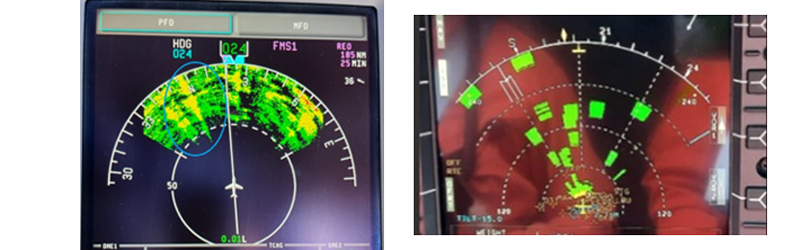
In aviation, Spoking is the general term for false weather radar returns in the form of radial lines or spokes. These lines generally extend outward from the airplane symbol on the display, or the source of the transmit pulse. They can be intermittent or continuous and may appear different depending on range, tilt, and/or gain settings.

The spokes usually rotate with the azimuth scan and may appear more intense than the surrounding weather, if any is present, appearing as a red spoke through a green or yellow weather cell. Interference can also appear as spokes, curved tracks, green blocks, and similar patterns. If it looks abnormal, then it may be unwanted spoking or interference.
Common Causes of Spoking

  • Magnetron Instability
    • Frequency jitter
    • Excessive RF (radio frequency) noise
    • Irregular pulse timing
  • Receiver Loss of Lock
    • Local oscillator issues
    • Receiver does not track magnetron pulse, causing AFC (automatic frequency control) sweeping, which can show spoking
  • Antenna or waveguide arcing
    • RF leakage or intermittent arcing can inject noise into the receiver
    • Spoking worsens in humid conditions
    • Burn marks may be present in waveguide sections
  • Antenna synchronization errors
    • Synchro/resolver issues or errors causing desync
    • Motor problems such as binding or intermittent windings
    • Intermittent wiring to motors/resolvers/position potentiometers

  Spoking.jpg     

Examples of radar spoking.

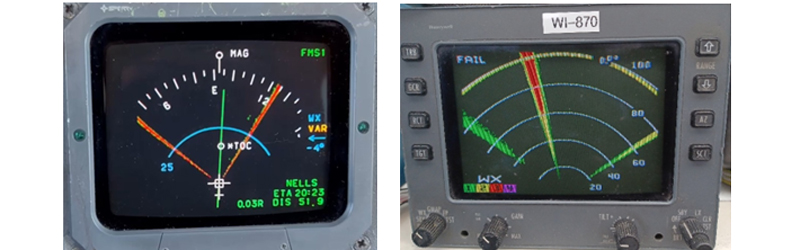
Common Causes of External Interference

  • DME equipment
  • HF Transmitters
  • SATCOM
  • Poor bonding or grounding, including moving pivots in the radar antenna itself
  • Nearby ground-based radar systems
  • Nearby aircraft weather radars

  Interference.jpg

Examples of external interference.

Troubleshooting questions to isolate spoking and interference:

These are some common questions to ask yourself and/or the pilot who has seen the issue in flight.

Do the spokes appear randomly or always in one quadrant?

Random locations: If the spokes appear randomly, common culprits include:

  • AFC sweeping issue
  • A loss of lock on the L.O. (local oscillator)
  • A poor or missing transmitter pulse

Single quadrant: If the spokes always appear in one quadrant, it is likely due to:

  • An antenna scanning issue
  • Intermittent wiring between the antenna base and the top-end of receiver/transmitter assembly.

Does spoking worsen with turbulence?

This can indicate antenna drive issues, bonding or grounding issues, or intermittent connectors/wiring.

Has maintenance been performed recently?

Maintenance can frequently be a catalyst for radar spoking.

  • If internal system maintenance was performed, the spoking may be due to disturbed or loose connectors, wiring, waveguides, or bonding.
  • If Radome or exterior maintenance was recently performed
    • Look for moisture trapped in the radome, which severely distorts or reflects the radar beam.
    • Paint issues: Use of non-approved, metallic, or excessively thick paint layers that attenuate the signal.
    • Improper repairs: Structural repairs that alter the Radome's transmissivity.
    • Grounding issues: Diverter strips or radome lightning protection are missing a solid path to the airframe ground.

Does it happen at altitude only?

If the spoking occurs only at altitude, this would point toward high-voltage issues. As altitude increases, electrical arcing can occur across larger gaps at the same voltage. This may be an internal receiver/transmitter problem related to temperature (cold soaked).

At Duncan Aviation, we have Technical Representatives ready to assist you with all of your radar and avionics troubleshooting needs. Once we narrow down the most likely cause, we have highly experienced technicians ready to repair/overhaul all of your avionics components.

Contact Duncan Aviation Component Services

For help troubleshooting radar spoking, interference, or any other component squawks, contact the Duncan Aviation Component Tech Rep team at LNK.ComponentTechReps@duncanaviation.com.

Contact

BOVAJ Jarrod Bovard Components Tech Rep Lincoln, NE (LNK) +1 402.470.4654