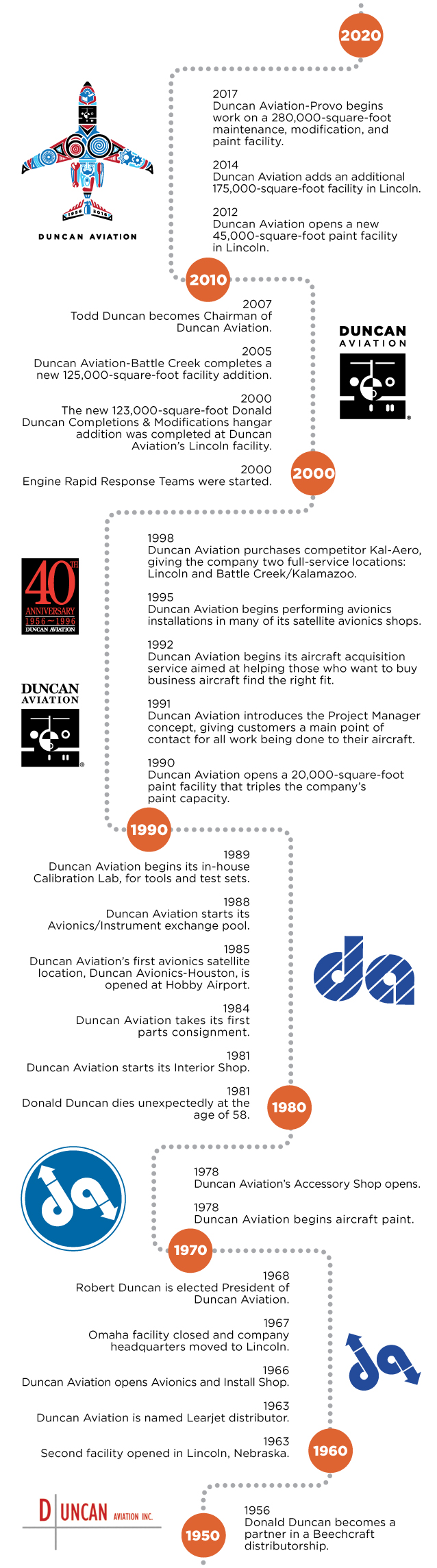
The true story of Duncan Aviation didn’t begin in 1956. It began in the depths of World War II on a farm outside Clarinda, Iowa, when Donald and Betty Duncan decided they wanted to learn to fly. After the war, Donald began purchasing surplus government aircraft. He would fly them for a few months, and then sell them for a profit. As Donald’s aviation interests grew, he became a partner in a Beechcraft distributorship in Omaha, Nebraska, and the roots of Duncan Aviation began. Donald sold hundreds of Beechcraft Bonanzas, Travel Airs, Twin Bonanzas, Barons and Twin Beeches.
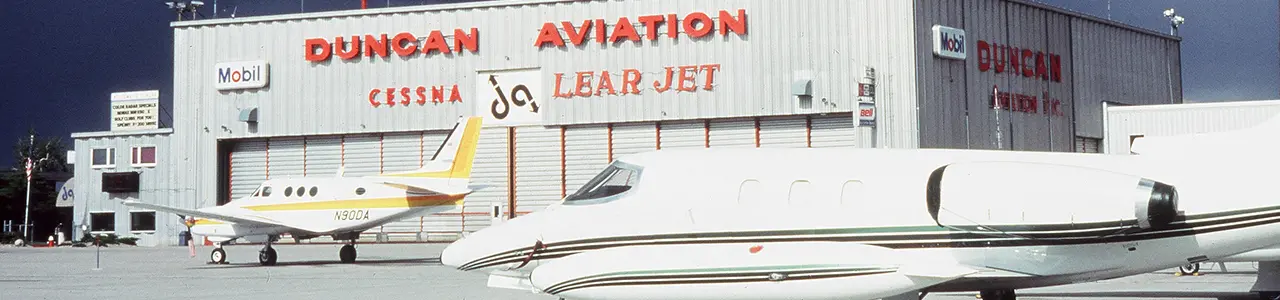
In 1963, a second facility was opened in Lincoln, Nebraska, at the new Lincoln Municipal Airport. In 1963 and 1964, Donald arranged to be a Learjet Distributor. It is quite possible that Bill Lear would have never been able to develop the world famous Learjet without Donald's backing and ingenuity. In 1967, Bill Lear sold Learjet to the Gates Rubber Company. The newly created Gates Aviation cancelled all existing US distributorships, including Duncan Aviation. However, Duncan Aviation was named the first Learjet Authorized Service Center in the world that same year. Donald continued buying new and used Learjets, and under his leadership, the company sold some 450 Learjets, most of these sales being made by Donald himself. The company maintained a presence in Omaha until 1967, when Donald moved the company's headquarters to Lincoln.
In 1968, Donald’s son Robert, who had worked full-time for the company for only three years, became President of Duncan Aviation. Although Duncan Aviation no longer had a jet distributorship, the company was recognizing a growing resale market for Learjets. Donald decided to make the company a major player in the jet aftermarket. At its high point in the 1970s, Duncan Aviation accumulated more than $40 million in leased and inventoried aircraft. Translated into today’s dollars, that’s close to a couple of hundred million. Donald never flinched in the face of these huge numbers, and this sales frenzy continued throughout the ‘70s. Donald Duncan passed away suddenly and unexpectedly on January 18, 1981. It was a devastating blow to the 25-year-old company and the entire Duncan family. “Nobody worked as hard as he did in that era. His work ethic was a heritage he left us with. He was hard to keep up with,” Robert reflects.
Throughout the 1980s and early ‘90s, Duncan Aviation grew in a multitude of areas. Many authorized service center designations were acquired including Citation, Astra/Westwind, Hawker and Falcon. The original equipment manufacturers of these aircraft recognized the benefits of having Duncan Aviation as a service center for their customers. Many partnerships with these manufacturers have been forged throughout their association with Duncan Aviation. In the mid-1980s, innovation developed. Many customers requested that Duncan Aviation’s avionics services be just around the corner. Out of an idea from Robert, the Duncan Aviation avionics Satellite Network was born, beginning in Houston, Texas. Today, the network boasts more than 25 locations at major executive airports across America. This concept put thousands of operators literally down the ramp from Duncan Aviation.
Today, the network contains a couple dozen locations at major executive airports across the US. This concept put thousands of operators literally down the ramp from Duncan Aviation.
By the 1990s, Robert began looking for someone new to run the day-to-day operations of the company. In 1996, Aaron Hilkemann came to the forefront of those considered. Aaron had a banking background, specializing in mergers and acquisitions. Duncan Aviation was on the cusp of a series of transitions that would nearly triple the size of the company and give it the capacity to serve many more customers than ever before. Under Aaron’s guidance, Duncan Aviation acquired Kal-Aero, a service competitor located in Battle Creek, Michigan. This gave Duncan Aviation two full-service MRO locations. The company also continued to grow its avionics network, opened an after-market parts business, and began locating engine teams throughout the United States for AOG and scheduled work.
In 2007, Robert retired and his son and longtime Duncan Aviation team member Todd Duncan was named Chairman.
As positive as things were for Duncan Aviation from 2001 to 2008, the family was reminded of how terribly cyclical this business can be with The Great Recession of 2008. It was one of the most difficult times at the organization and in business aviation.
Slowly, the company and its resilient team members worked beyond this dark time. After putting expansion plans in Provo, Utah, on hold for more than seven years, Duncan Aviation built and invested more than $65 million in a greenfield build of a third major site, opening the first of two new hangars there in January 2019. By mid-2020, the back shops and office areas were complete and the company weathered the Covid 19 pandemic well.
In 2023, Duncan Aviation built new maintenance hangars in both Lincoln and Battle Creek. Then, in 2024, the company embarked on a significant expansion of its turbine engine overhaul facility in Lincoln. This followed an announcement made during the 2023 NBAA BACE convention by P&WC (Pratt & Whitney Canada) designating Duncan Aviation’s MRO facility in Lincoln as a DOF, or Designated Overhaul Facility, for PW300 and PW500 turbofan engines. This designation drastically increases the company’s engine capabilities and business.
Todd’s twin boys, Harrison and PK, have both joined the company and look forward to continuing its traditions. Duncan Aviation has a strong foundation. The company is excited that its brand will live on to the 4th generation. The Duncan family knows that the strong Duncan Aviation brand was built and is sustained by its talented and experienced team that now numbers more than 3,000. In 2025, Duncan Aviation inducted its 715th team member into the Silver Wings Club, which celebrates team members who have worked for the company for 25 years. Although many lifetime members are now retired, it is a membership that continues to grow with inductions made every two years.
In 2026, Duncan Aviation celebrates its 70th year in business. Duncan Aviation has a history of trying new ideas and an ability to innovate and transition itself into future aviation trends. Duncan Aviation believes that the most important element to customer satisfaction is the quality of its workforce and the training its team members receive. At Duncan Aviation, transitions are viewed as opportunities to look past the next cloud. It’s a legacy that Donald Duncan left as a continuing challenge for every member of the great aviation team he inspired more than 70 years ago.